Cold School Closures: Snow Day Calculator
SnowDayPlanner
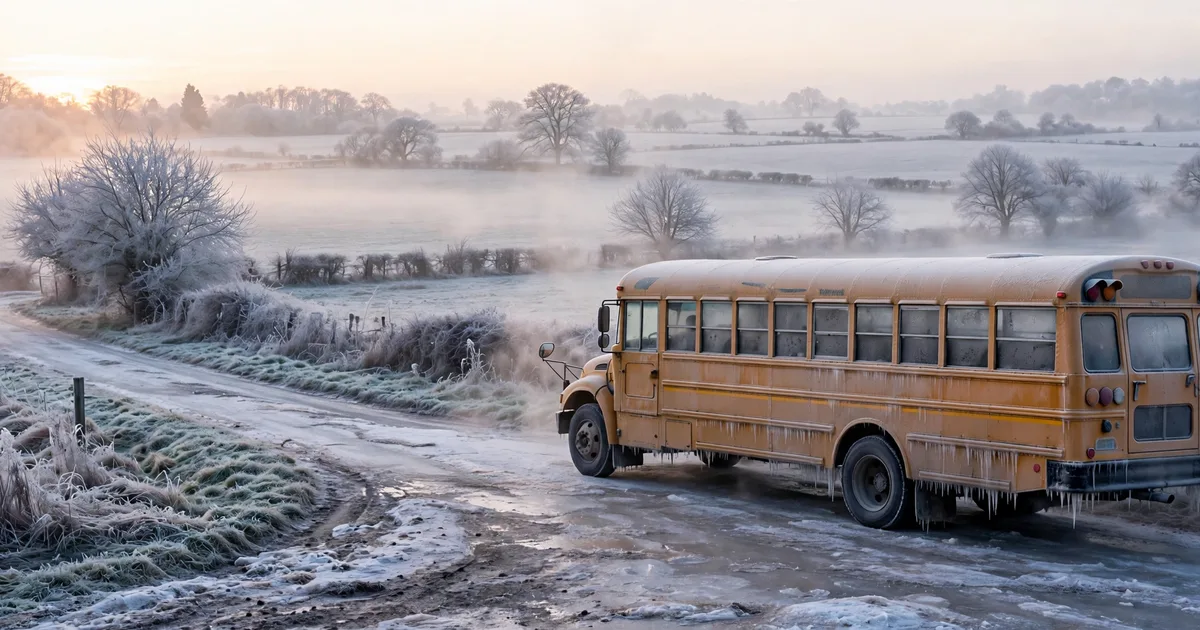
Can cold alone cancel school — with no snow on the ground at all? Yes, and it happens every winter. On Friday, November 13, 2026, the season's first freeze swept western North Carolina, and three neighbouring counties answered it three different ways: Avery County Schools moved to virtual learning, Madison County Schools closed for the day, and Yancey County Schools took a two-hour delay. Same cold snap, same morning, three different decisions. This guide explains how freezing temperatures close schools, what the thresholds are, and how to tell a delay from a virtual day from a full closure — with the Snow Day Calculator to check your own chances.
What happened on Friday, November 13, 2026
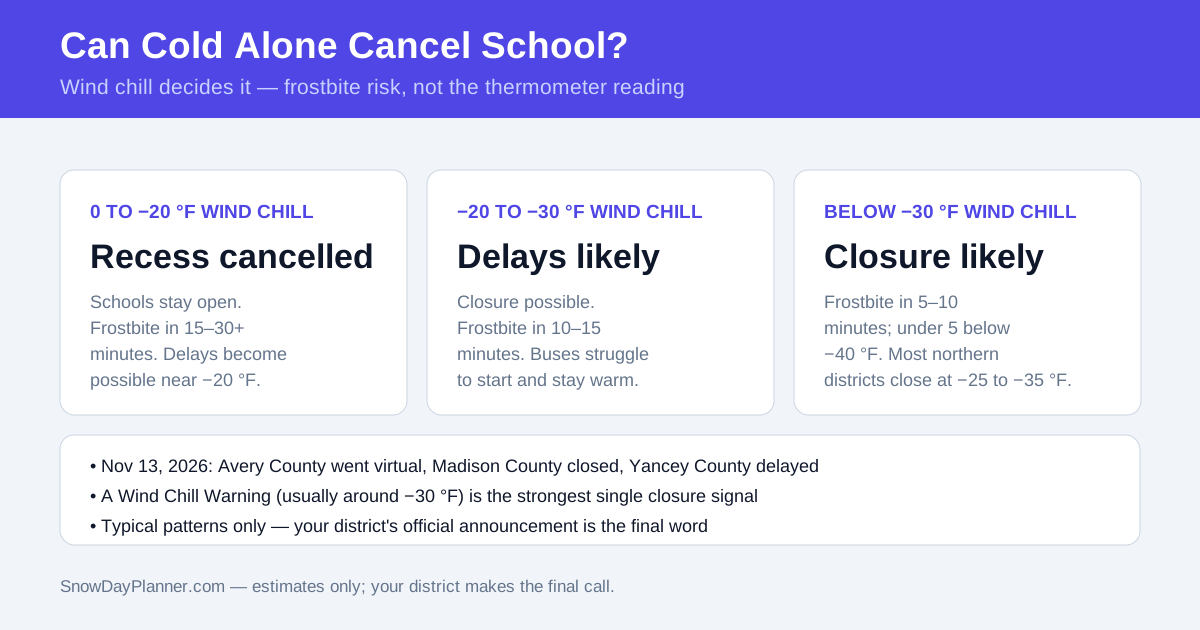
The first freeze of the season arrived in the North Carolina mountains on Friday, November 13, 2026, with snow showers riding in on the cold air. The National Weather Service office in Greenville-Spartanburg forecast lows in the upper 20s for Avery, Madison and Yancey counties, with a chance of snow showers and little accumulation — and a storm report that morning logged 2 inches of snow near Grandfather Mountain in Avery County. By 6:20 AM, the school-closure list published by FOX Carolina showed the split: Avery County Schools on virtual learning for the day, Madison County Schools closed with an optional teacher workday, and Yancey County Schools on a two-hour delay.
Yes — cold alone can cancel school
Most people picture a snow day as a snowstorm. But in the northern United States, extreme cold closes schools about as often as snow does, and in Minnesota and Wisconsin it is the main closure cause in many winters. The mechanism is different: snow closes schools by making roads impassable, while cold closes them by making the wait outside dangerous and the machinery unreliable.
The number that matters is almost always wind chill, not air temperature. Wind chill measures how cold exposed skin actually feels when wind strips away the thin layer of warm air around it. At 0 °F on a calm day you are cold but safe for a while; add a 20 mph wind and the wind chill falls to about −22 °F, cold enough to cause frostbite on exposed skin in roughly half an hour.
How cold is too cold for school?
Thresholds vary by region and by district, but the pattern below is what most districts use, built from National Weather Service guidance and common district policies.
| Wind chill | Typical action | Frostbite risk (exposed skin) |
|---|---|---|
| 0 to −10 °F | Outdoor recess cancelled | 30+ minutes |
| −10 to −20 °F | Recess cancelled; delays possible | 15–30 minutes |
| −20 to −30 °F | Delays likely; closure possible | 10–15 minutes |
| −30 to −40 °F | Closure very likely | 5–10 minutes |
| Below −40 °F | Almost certain closure | Under 5 minutes |
Most northern districts set their closure line somewhere between −25 °F and −35 °F wind chill. Real district policies show the spread: one Idaho district closes when the air temperature falls below −20 °F or the wind chill below −30 °F, while a Minnesota district acts when the 6:30 AM wind chill is forecast at −35 to −40 °F. Southern districts close far earlier, often around −20 to −25 °F wind chill. The National Weather Service's cold and wind chill safety pages explain the frostbite timings behind these numbers.
Why districts close for cold: four reasons beyond the thermometer
Children waiting outside
This is the first and most important reason. A child waiting 10 to 15 minutes for a bus in −30 °F wind chill can develop frostbite on exposed cheeks, ears and fingers in about 10 minutes. Districts cannot guarantee every child is dressed for it, and they cannot guarantee the bus arrives on time.
Buses that will not start — or will not stay warm
Diesel school buses are famously stubborn in extreme cold: fuel gels, batteries weaken, and engines that sat overnight may not turn over at all.
Frozen pipes and cold buildings
Schools are big, old buildings with miles of pipe. A hard freeze can burst pipes, knock out heat in a wing, or leave a building at 55 °F by morning — too cold for children to sit in all day.
Icy roads the snow never caused
Cold day vs snow day: how the decision differs
A snow decision is mostly about totals and timing: how much fell, when it falls, and whether plows can clear it before the buses run. A cold decision is mostly about duration: how long the dangerous wind chill lasts, and whether it lifts before the morning commute. If the dangerous cold hits at 3 AM but lifts by 7 AM, many districts will open on time or use a two-hour delay; if −30 °F wind chill is forecast to persist through the whole morning, closure becomes far more likely.
Delay, virtual day or closure: what each one means
| Option | What happens | When districts choose it |
|---|---|---|
| Two-hour delay | School starts two hours late; buses run late | Cold or roads expected to improve by mid-morning |
| Virtual / remote day | Students learn from home; day counts | Buildings or buses unusable, but learning can continue |
| Full closure | No school; day usually made up later | Conditions unsafe all day, or remote learning impractical |
A virtual day, like Avery County chose on November 13, keeps the day counting toward the required school year without putting children on cold buses; a full closure, like Madison County chose, is the answer when even remote learning is not the right call. Keep a backup plan in place until the buses are actually rolling, because a delay is a forecast, not a promise.
The three options are a ladder, not three separate decisions.
What to do on a freezing school morning
Check the district's announcement first, in the evening and again at 5:30 AM — most cold closures are decided in that same early-morning window as snow days, once the overnight low and the wind chill forecast are known. Then check the Snow Day Calculator: enter your ZIP code for a live probability built from the next 24 hours of weather, including wind chill, and read tomorrow's snow day chances before bed. Dress children in layers with covered ears, fingers and cheeks, and keep them waiting indoors or in a warm car until the bus is actually in sight.
Frequently asked questions
Can cold alone cancel school?
Yes. Extreme cold closes schools with clear skies, most often when the wind chill reaches roughly −25 to −35 °F. The danger is frostbite for children waiting at bus stops, buses that will not start or stay warm, and frozen pipes and buildings — not snow on the roads.
How cold does it have to be to close school?
There is no national number. Most northern districts close around −25 to −35 °F wind chill; southern districts often close around −20 to −25 °F. The National Weather Service's frostbite guidance is the backbone: at −30 °F wind chill, exposed skin can freeze in about 10 minutes.
What is the difference between a delay and a closure for cold?
A delay bets the cold will lift by mid-morning — the sun warms the roads, buses start, and school runs two hours late. A closure means conditions are expected to stay dangerous all day, or the buses and buildings cannot be made safe at all. A delay can be raised to a closure if the follow-up check still finds unsafe conditions.
Why did three North Carolina counties decide differently on November 13, 2026?
Because the same forecast meets different ground: elevation, mountain bus routes, building readiness and local judgment. Avery County chose virtual learning, Madison County closed, and Yancey County took a two-hour delay — all reasonable answers to the same first freeze, reported by FOX Carolina in its 6:20 AM update that morning.
Can I check tonight's cold-closure chances?
Yes — enter your ZIP code in the Snow Day Calculator for a live probability from tonight's forecast, including wind chill, and check your district's own channels for the official announcement.
These thresholds are general guidelines drawn from typical district practice and National Weather Service guidance, not any district's policy. Always follow your district's official announcement. SnowDayPlanner provides forecast-based estimates only; the final decision always belongs to your school district.
About the SnowDayPlanner Team
The SnowDayPlanner Team runs the snow day prediction model behind this site, combining live forecast data — snowfall, ice, wind chill and timing — with the closing patterns of thousands of school districts and boards. We publish how the model works and how accurate it has been, and we refresh predictions through the night as forecasts change, so the score you check in the morning reflects the latest data.