How Many Snow Days Do Schools Get?
SnowDayPlanner
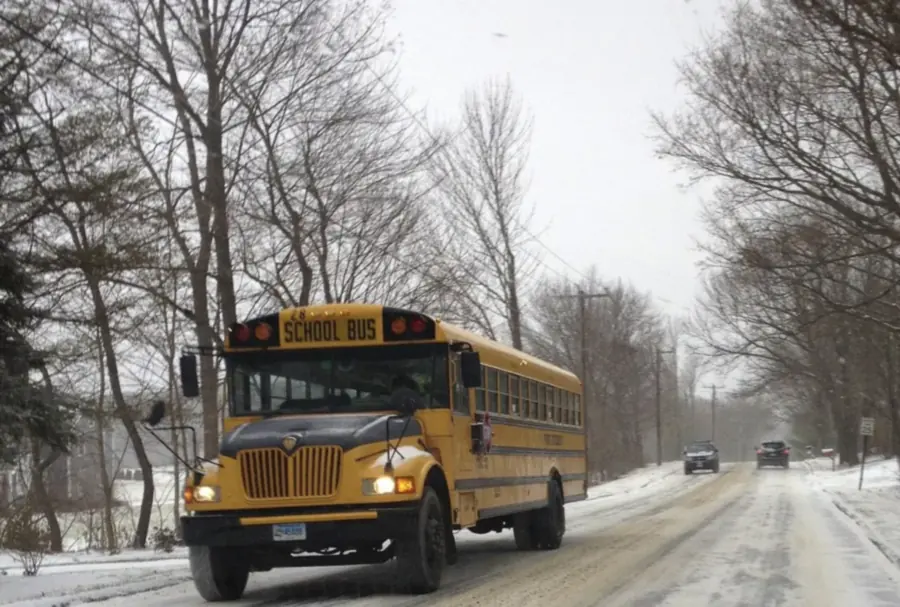
How many snow days do schools get? There is no single national number — and that is exactly why parents keep asking. The answer lives in three different places: the cushion of days your district builds into its calendar, the number your state forgives by law, and the virtual days your state lets count as real school. A family in Michigan and a family in Ohio can watch the same storm and get completely different answers, because their states count snow days in completely different ways.
This guide lines up the numbers state by state, explains what a "built-in" day actually is, and shows you how to find the one number that matters for your family: how many your own district has left.
The short answer
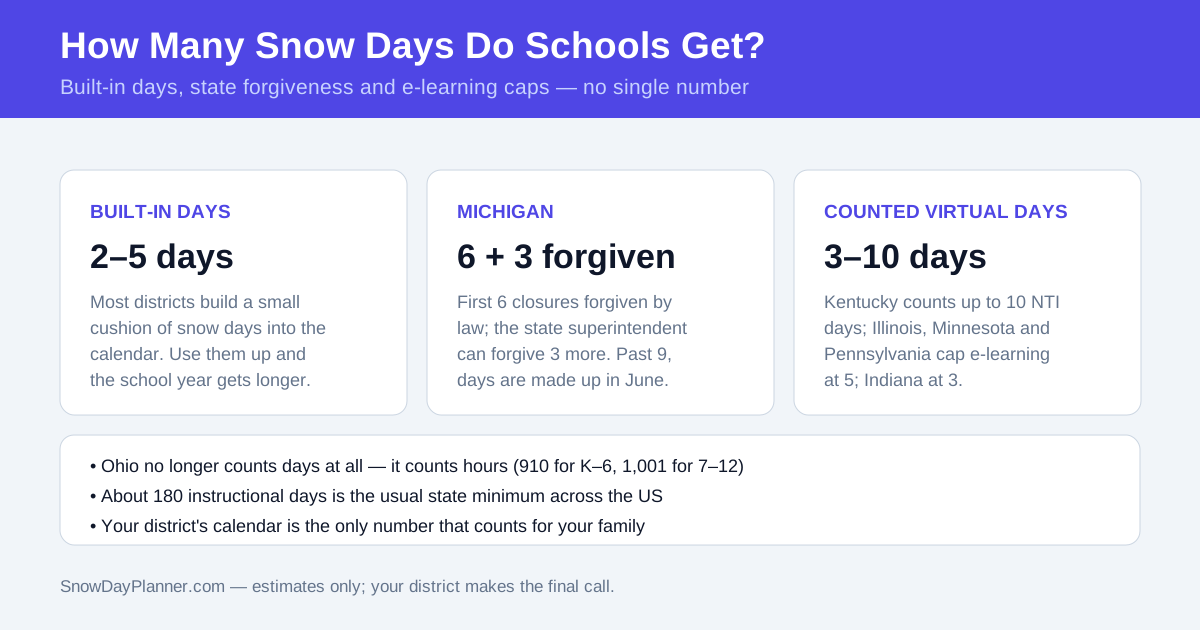
Most districts build 2 to 5 snow days into the school calendar — days already in the schedule as a cushion, so using them changes nothing. Beyond that cushion, the count depends on the state. Michigan forgives the first 6 closures by law and can forgive 3 more. Ohio stopped counting days entirely and counts hours instead. Kentucky lets up to 10 closure days count as instruction through its NTI program, while Illinois, Minnesota and Pennsylvania cap counted e-learning days at 5, and Indiana at 3. When every allowance runs out, the days get made up — usually by extending the school year into June.
What a "built-in" snow day actually is
When districts publish the school calendar in August, most of them quietly include a few extra days beyond the state minimum — typically two to five. Those are the built-in snow days. They are not days off; they are spare days sitting inside the calendar, waiting to absorb the winter. If the winter is mild, the cushion is never spent and the year ends on the printed date. If the storms come, each closure spends one day of cushion and the calendar does not move.
Think of it like a budget. A district that builds in five days can absorb five closures without changing a thing. The sixth closure is when the real decisions start: make-up days, waivers, or virtual instruction. That is why two districts in the same county can behave differently in February — one still has cushion and closes generously, the other has spent it and starts choosing two-hour delays instead. Our guide to whether snow days have to be made up explains the five ways a missed day gets absorbed once the cushion is gone.
How many snow days do schools get, state by state?
| State | Snow days allowed | What happens after |
|---|---|---|
| Michigan | 6 forgiven by law, +3 more by state waiver | Make up in June past 9 |
| Ohio | No fixed number — hours, not days (910 hrs K–6, 1,001 hrs 7–12) | Extend the year if hours fall short |
| Kentucky | Up to 10 NTI days count as school | 11th closure is a traditional snow day |
| Minnesota | Up to 5 e-learning days | Make-up days past the cap |
| Illinois | Up to 5 e-learning days | Make-up days past the cap |
| Pennsylvania | Up to 5 Flexible Instructional Days | Make-up days past the cap |
| Indiana | Up to 3 e-learning days | Make-up days past the cap |
Read the table as allowances, not guarantees. A district can always close for safety — the allowance decides whether the closure has to be paid back, not whether it can happen. And a district that has already spent its allowance does not stop closing; it starts paying the days back in June, or taking back a scheduled break. The allowance is a budget, and like any budget, the pain arrives when it runs out.
Why the number is different in every state
Days versus hours
Most states set a minimum school year of about 180 instructional days, and closures that drop a district below it have to be recovered somehow. Ohio broke with that model in the 2014–15 school year: districts there must deliver minimum instructional hours instead — 910 hours for full-day kindergarten through grade 6, and 1,001 hours for grades 7 through 12. There is no statutory cap on how many days an Ohio district may close; the legal trigger is simply whether closures would push the district below its required hours. Districts schedule excess hours above the minimum as the cushion, and up to three days of lost instruction can be made up online under a plan the board adopts by August 1.
Forgiveness laws
Michigan writes its cushion into statute. Under Section 101 of the State School Aid Act, the first six days a district cancels for conditions beyond its control are forgiven — they still count toward the required 180 days and 1,098 hours — and the state superintendent can forgive up to three more in unusual circumstances. Our Michigan snow day guide explains the rule in full, including why a district that has burned through its six by February gets noticeably stingier about closing. After exceptional winters, legislatures sometimes forgive extra days by special act — but that is the exception, not the plan.
Counted virtual days
The third way states stretch the number is to let a closure day count as a school day when learning moves home. Kentucky's Non-Traditional Instruction program is the most generous — up to 10 days a year count as attendance. Illinois, Minnesota and Pennsylvania cap their versions at 5 days, Indiana at 3, and the rules differ on what counts: live teaching, self-paced assignments, or a mix. Our comparison of snow days vs e-learning days lays out how each state's framework works — and where the caps bite when a hard winter runs past them.
What happens when the snow days run out
Once the built-in days, the forgiveness allowance and the virtual-day cap are all spent, the missed days come back — most commonly as days added to the end of the school year in June, which is why the printed last day of school is always provisional until spring. Districts also take back scheduled breaks (Presidents Day is the classic make-up day), lengthen the school day, or hold Saturday sessions. After a truly exceptional winter, a district can ask the state for a waiver, and states occasionally grant one. None of this changes the safety call on any given morning; it only changes what the calendar looks like in June.
How to find your district's number in five minutes
Three checks, and you will know exactly where your family stands. First, find your district calendar's count of built-in make-up days — it is usually printed on the calendar itself or in the student handbook. Second, find the printed latest-possible last day of school; that is the date the year ends in if every built-in day gets used. Third, count how many closures your district has already used this winter, from the district's own announcements. If closures are approaching the cushion, treat the latest last day as the real one for any June booking — and check the forecast the night before a storm so a closure is a plan, not a surprise.
Check your chances tonight
Allowances tell you the budget; tonight's forecast tells you whether you will spend one. Enter your ZIP code in the snow day calculator on our homepage for a live probability built from the next 24 hours of weather, read how the score works to see the formula behind it, and check tomorrow's snow day chances in the evening and again at 5:30 AM. For official winter-safety guidance, the National Weather Service's winter safety pages are the authoritative source.
Frequently asked questions
How many snow days do schools get in a year?
Most districts build 2 to 5 snow days into the calendar. State rules then add more: Michigan forgives 6 closures by law plus 3 more by waiver, Ohio counts hours instead of days, and several states let 3 to 10 virtual days count as school. The exact number for your family is on your district's calendar.
Do snow days have to be made up?
In most states, yes — unless the calendar's built-in cushion, a state waiver, or a counted virtual day absorbs them. States set a minimum instructional year, and closures that drop a district below it have to be recovered somehow, usually in June.
How many snow days does Michigan allow?
Six come free. Under Section 101 of the State School Aid Act, the first six days a Michigan district cancels for conditions beyond its control are forgiven, and the state superintendent can forgive up to three more — nine in total. Past nine, the days have to be made up.
What is a built-in snow day?
A spare day already inside the published school calendar, beyond the state minimum. Using one changes nothing — the year still ends on the printed date. Once the built-in days are spent, closures start pushing the last day of school later.
How do I find how many snow days my district has left?
Check three things: your district calendar's built-in make-up day count, the printed latest-possible last day of school, and how many closures the district has already announced this winter. The gap between the cushion and the closures used is what is left.
These allowances are general rules drawn from state law and typical district practice, not any district's policy. Always follow your district's official announcement. SnowDayPlanner provides forecast-based estimates only; the final decision always belongs to your school district.
About the SnowDayPlanner Team
The SnowDayPlanner Team runs the snow day prediction model behind this site, combining live forecast data — snowfall, ice, wind chill and timing — with the closing patterns of thousands of school districts and boards. We publish how the model works and how accurate it has been, and we refresh predictions through the night as forecasts change, so the score you check in the morning reflects the latest data.