How Accurate Is a Snow Day Calculator?
SnowDayPlanner
If a snow day calculator shows a 70%, 80%, or even 90% chance of school closing, the obvious question follows: how accurate is that prediction? The honest answer for the 2026-27 season is that a snow day calculator gives you a probability estimate, not a guarantee — and understanding what sits behind the number makes you a much better reader of it. This guide explains snow day calculator accuracy in plain terms: what accuracy means, which inputs matter most, why predictions miss, and how to use the odds without being fooled by them.
Two different kinds of uncertainty are baked into every prediction. The first is weather uncertainty: the forecast itself can shift. The second is decision uncertainty: the superintendent's final call depends on local facts no website can fully see. A good calculator is transparent about both. Any tool that hides them behind a single confident percentage deserves skepticism.
What "accurate" actually means for a snow day calculator
Accuracy for a snow day calculator is usually quoted as the share of past predictions that matched what districts actually did. That sounds simple, but the details matter enormously. Was the prediction recorded before the district announced, or reconstructed afterwards? Did it count every prediction, or only the confident ones? Over how many storms, districts, and winters? A claim like "87% accurate" means very little without those answers.
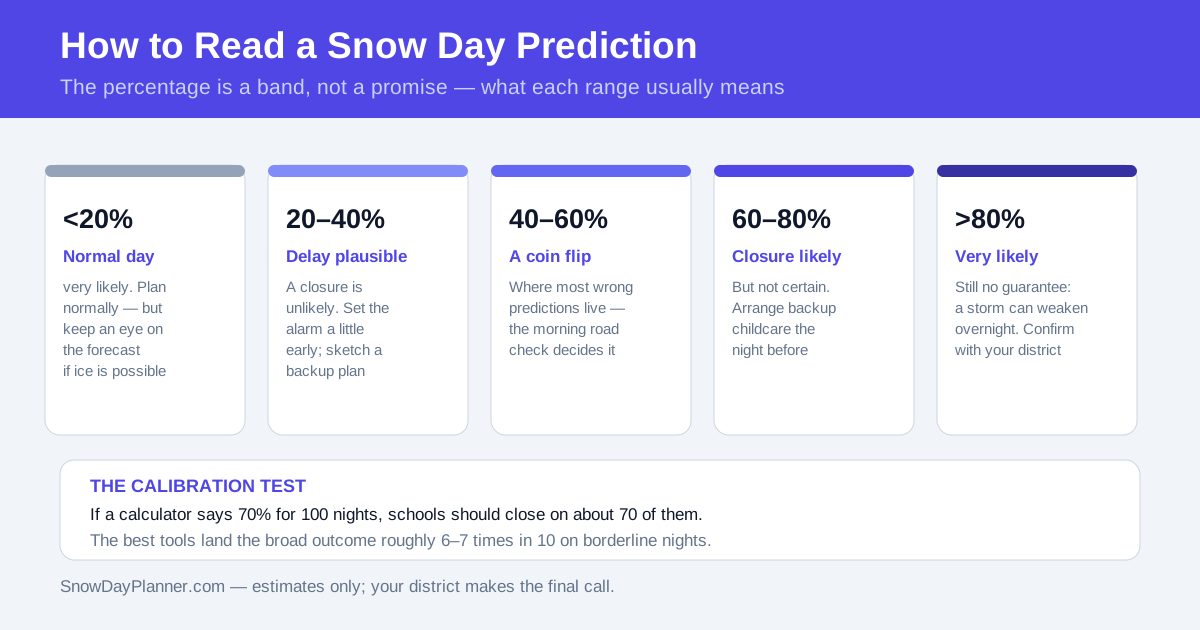
There is also a subtler point: a probability is not a pass-or-fail guess. If a calculator says 70% for a hundred different school nights, and schools close on about seventy of those nights, the calculator is well calibrated — even though it was "wrong" thirty times. Judging a single 70% prediction as right or wrong misses the point. The right question is whether the tool's percentages match reality over many nights, and whether high percentages close more often than low ones.
That is why the most honest tools describe their output as a weather-based probability estimate. Until a tool has published a large, pre-registered dataset of predictions recorded before announcements and compared with actual outcomes, a precise accuracy percentage is marketing, not measurement.
The inputs that matter most
Not every input moves the odds equally. These are the ones that decide most predictions, in rough order of importance:
| Input | Why it matters | How it can go wrong |
|---|---|---|
| Forecast snowfall amount and rate | The core driver: heavy snow overwhelms plows and slows buses | Forecast totals shift by inches as the storm track moves |
| Ice or freezing rain | Ice closes schools at any snow total; salt works slowly on it | A small temperature error flips rain to ice, or the reverse |
| Storm timing | Snow during the 6–9 a.m. commute is far more disruptive than overnight snow | A storm arriving hours early or late changes the whole call |
| Wind chill and temperature | Extreme cold closes schools with no snow at all | Wind forecasts are less precise than temperature forecasts |
| Wind and visibility | Blizzard conditions close schools even at moderate totals | Blowing snow is hard to forecast street by street |
| Active winter-weather alerts | Warnings signal forecaster confidence and storm severity | Alerts cover whole counties, not your district's roads |
| District closing tendency | Some districts close early; snow-hardened ones rarely do | Past behavior is a guide, not a rule — policies and superintendents change |
Notice what is missing from the table: your district's actual road conditions, its plow fleet status, its bus routes, and how many snow days it has left. Those are among the biggest real-world factors, and no public calculator can observe them directly. That gap alone caps how accurate any snow day calculator can be.
How to read a prediction: the bands
Think of the percentage as a band, not a point. Roughly:
- Under 20%: a normal school day is very likely. Plan normally, but keep an eye on the forecast if ice is possible.
- 20–40%: a delay is plausible, a closure unlikely. Set the alarm a little early and have a backup plan sketched out.
- 40–60%: a genuine coin flip. This is where most "wrong" predictions live — the storm is borderline, and the district's morning road check will decide it.
- 60–80%: a closure is likely, but not certain. Arrange backup childcare the night before.
- Over 80%: a closure is very likely. Still not a guarantee — a storm can weaken overnight, or a district can decide to run with a delay.
The most useful habit is checking twice: once the night before, to arrange childcare and set expectations, and again in the early morning, when the forecast has sharpened and the district's road check is under way. A prediction that jumps from 35% to 75% overnight is telling you the forecast changed — trust the newer number more, and always confirm with your district.
Why predictions miss
When a prediction misses, one of a few usual suspects is responsible. First, the forecast moved: the storm track shifted twenty miles, the snow arrived as rain, or the ice never formed. Short-term forecasts (within 24–48 hours) are fairly reliable, but accuracy drops sharply beyond two or three days — a six-inch forecast three days out can easily become two inches, or zero, by the morning.
Second, the district saw something the calculator could not: a drifted rural route, a plow breakdown, a power outage at a school, or a staffing shortage. Third, the district's context changed the calculus: a district that has already used its snow days may stay open in marginal weather, while a district with days to spare may close. Fourth, lake-effect bands: a band can sit over one district and miss the next, and county-level forecasts cannot resolve that. Finally, timing: a storm that ends by midnight gives plows hours; the same storm ending at 7 a.m. closes schools.
None of this means calculators are useless. It means they are planning tools, not announcements. A prediction that says 65% has done its job if it prompts you to arrange backup care — even on the nights when school stays open.
Accuracy claims: what to believe in 2026-27
You will see snow day calculators advertised as "90% accurate," "95% accurate," or even higher. Treat any such claim as unproven unless the tool shows its work: predictions logged before district announcements, compared against actual outcomes, across a large number of storms and districts, with misses included. Tools that only count their confident predictions, or that quietly revise old predictions after the fact, will always look more accurate than they are.
The credible pattern in the field is more modest: short-term snowfall forecasts are right within a couple of inches most of the time, and the best calculators get the broad outcome right roughly six to seven times in ten on borderline nights, more often on clear-cut storms. That is genuinely useful — and it is a very different claim from a guaranteed percentage. Our own accuracy page explains how we track our predictions against outcomes, and our how it works page shows exactly which inputs feed the score.
How to use a snow day calculator this season
- Check the night before, and again in the morning. Forecasts sharpen overnight; the morning number is the one to act on.
- Read the band, not the digit. 68% and 73% mean the same thing: likely, not certain.
- Look at the hourly forecast behind the number. Snow at 3 a.m. and snow at 7 a.m. are different school days.
- Weight ice heavily. If freezing rain is in the forecast, treat any prediction as more closure-prone than the snow total suggests.
- Know your district. Rural routes, a new superintendent, or exhausted snow days all shift the real odds away from the calculator's baseline.
- Always confirm with your district. The district website, app, or automated message is the only authoritative source — including on nights the calculator says 95%.
Try it for your own ZIP code in our snow day predictor or school closing predictor, and if you live in Michigan, read our Michigan snow day guide for the lake-effect and six-day context behind your local odds.
Frequently asked questions
How accurate are snow day calculators?
They give probability estimates, not guarantees. Short-term forecasts are fairly reliable, but no calculator can see your district's roads, plows, or bus routes — so even a good tool misses borderline nights. Judge a tool over many nights, not one prediction.
Can a snow day calculator guarantee a closure?
No. A 90% prediction still means roughly one night in ten goes the other way, and a district can always surprise the model with local information. Only the district's announcement is final.
Why was the prediction wrong for my district?
Most often the forecast shifted, the storm's timing changed, lake-effect bands hit unevenly, or the district weighed local road and staffing facts the calculator cannot see.
Is a calculator more accurate the night before or in the morning?
In the morning. Forecasts sharpen as the storm approaches, so the early-morning prediction is usually the most reliable — check twice, and act on the newer number.
Should I trust a calculator that claims 95% accuracy?
Only if it shows its work: predictions logged before announcements, compared with real outcomes, across many storms and districts, misses included. Without that, the number is marketing.
Snow day calculators are planning tools, not announcements. Use the odds to prepare — arrange backup care, set the alarm early, check twice — and always follow your district's official decision. For the official forecast behind any prediction, see the National Weather Service, and for an independent discussion of accuracy claims, see how accurate snow day calculators really are.
About the SnowDayPlanner Team
The SnowDayPlanner Team runs the snow day prediction model behind this site, combining live forecast data — snowfall, ice, wind chill and timing — with the closing patterns of thousands of school districts and boards. We publish how the model works and how accurate it has been, and we refresh predictions through the night as forecasts change, so the score you check in the morning reflects the latest data.