NY Snow Day Calculator: New York Guide
SnowDayPlanner
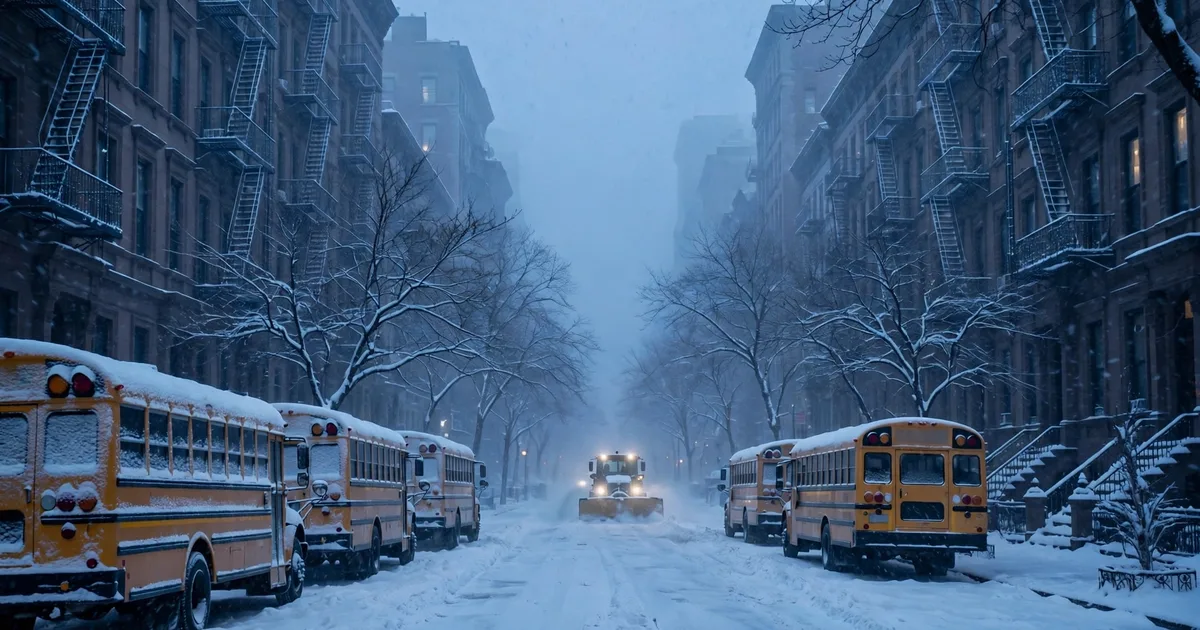
Ask a parent in Buffalo and a parent in Brooklyn the same question — "will there be a snow day in New York tomorrow?" — and you will get two completely different answers, because New York is really several winter states in one. A nor'easter that buries Long Island can leave the city open, lake-effect bands can close Syracuse while Albany stays dry, and New York City itself almost never closes at all. This guide explains how districts across the state actually decide, what snowfall it usually takes, when the announcement lands, and how to read tonight's forecast with the Snow Day Calculator.
One thing first: this is a guide, not a forecast for a particular storm. There is no major storm in the forecast for Monday, November 16, 2026 — every city in our forecast list shows a 0% school-closing chance for the day. What follows is the decision pattern you can use all winter, for any storm.
The short answer: will New York get a snow day tomorrow?
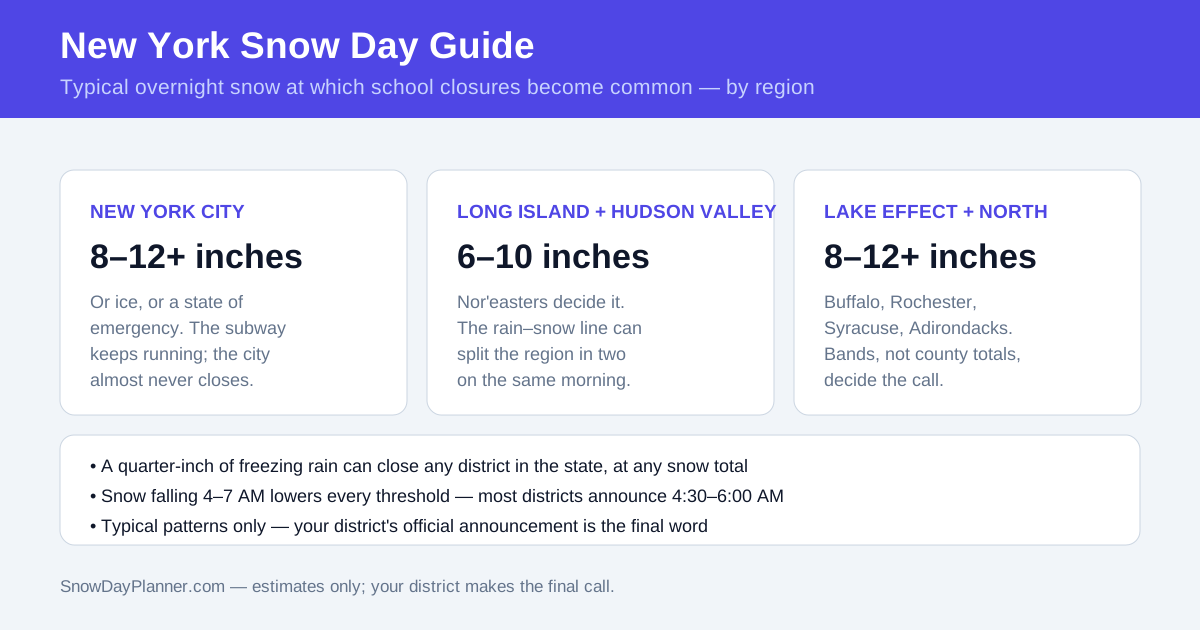
For Monday, November 16, 2026: no. With no snow, ice or dangerous cold in the forecast, schools across New York should open on a normal schedule. The Snow Day Calculator gives New York City a 0% chance for the day, and the same picture holds upstate. But "tomorrow" is the wrong question to ask once and forget — the useful question is what has to change before the answer flips. In most of New York, that means roughly 6 to 10 inches of snow falling overnight, a coating of freezing rain, or a morning wind chill far below zero. In New York City, the bar is higher still: it takes a major storm, usually 8 to 12 inches or more, often with a state of emergency, before the nation's largest school system closes its doors.
Who decides if New York schools close?
There is no statewide snow-day rule in New York. Each district's superintendent makes the call for that district, usually after a pre-dawn road check by the transportation director and facilities staff. The state sets the school calendar — 180 days of instruction — but it does not order districts open or closed for weather.
New York City is the exception in scale, not in principle. The decision for New York City Public Schools rests with the Chancellor, working with the Mayor's office and emergency management. Its first traditional snow day since 2019 came in February 2026, when a blizzard brought a local state of emergency and a travel ban.
Upstate, the decision is more local and more frequent. Districts in the lake-effect belts around Buffalo, Rochester and Syracuse, and in the Adirondacks and North Country, close several times most winters.
How much snow closes schools in New York?
The table below gives the typical ranges districts in each region work with.
| Region | Delays become common | Closures become common | What usually decides it |
|---|---|---|---|
| New York City | Rare — remote day instead | 8–12+ in, or ice / emergency | Subway keeps running; meals and shelter matter |
| Long Island | 3–6 in | 6–10 in | Nor'easters; the rain–snow line |
| Hudson Valley and Albany | 3–6 in | 6–10 in | Nor'easters; icing on hills and bridges |
| Syracuse, Rochester and Buffalo | 4–6 in | 8–12 in | Lake-effect bands; whiteouts |
| Adirondacks and North Country | 4–8 in | 8–12+ in | Deep snow; long rural routes |
| Southern Tier (Binghamton area) | 3–6 in | 6–10 in | Elevation changes; icing |
Two things move every number in that table. The first is timing: six inches that ends by midnight is a plow problem crews solve before dawn, while three inches arriving between 4 and 7 AM lands directly on the bus runs and can close schools at half the total. The second is ice: a quarter-inch of freezing rain can close any district in the state, at any snow total, because it coats every surface at once and defeats careful driving.
When do New York districts announce a snow day?
Most districts announce between 4:30 and 6:00 AM, after the pre-dawn road check. The timing is a compromise: earlier means guessing about roads the buses have not driven yet; later means families are already on those roads. When a storm is certain — a blizzard warning posted the day before, a nor'easter with a confident track — many districts announce the night before, often by 8 or 9 PM, so families can plan childcare.
New York City usually announces the evening before a major storm, because moving a million students needs lead time. Upstate districts with lake-effect snow often cannot decide until morning, because a band can shift twenty miles overnight and change one county's total by six inches. If you are checking, check twice: once in the evening, and again at 5:30 AM. And check the district's own channels — its website, app, or phone line — not a neighbour's group chat.
Lake effect, nor'easters and ice: New York's three storm types
Lake-effect snow
Cold air crossing the relatively warm water of Lake Erie and Lake Ontario picks up moisture and drops it as narrow, intense bands of snow. Buffalo, Rochester, Syracuse and the Tug Hill Plateau can get a foot of snow while a town twenty miles away gets flurries.
Nor'easters
The big coastal storms that climb the Atlantic seaboard bring the state's heaviest snowfalls to New York City, Long Island and the Hudson Valley, often 8 to 18 inches with high winds. A nor'easter's rain–snow line is its cruelest feature: Long Island can get rain while Westchester gets a foot of snow, and districts on either side of the line make opposite calls on the same morning.
Freezing rain and ice
Ice is the great equaliser. It closes New York City as readily as it closes a rural Adirondack district, because no plow fleet and no subway can fix an ice-coated road. Storms that mix rain, sleet and snow near freezing — common in the Hudson Valley, the Capital Region and the Southern Tier — are the slickest combination there is. If the forecast says "freezing rain," treat it as a closure warning whatever the snow total says.
Remote learning days vs old-fashioned snow days
New York has moved, like most states, toward remote learning days instead of traditional snow days.
How to check your chances tonight
Thresholds tell you the pattern; tonight's forecast tells you the answer. Enter your ZIP code in the Snow Day Calculator for a live probability built from the next 24 hours of weather, check the New York page for the regional pattern behind the number, and read tomorrow's snow day chances in the evening and again at 5:30 AM. For authoritative winter-safety guidance, the National Weather Service's winter safety pages are the source to trust, and New York City families should also watch the official New York City Public Schools channels for the final word.
Frequently asked questions
Will there be a snow day in New York tomorrow?
For Monday, November 16, 2026, no — no snow, ice or dangerous cold is forecast anywhere in the state, and the Snow Day Calculator gives New York City a 0% chance. For any other day, enter your ZIP code in the calculator the evening before and check again at 5:30 AM; the answer changes with each forecast update.
How much snow does it take to close schools in New York?
Typically 6 to 10 inches of overnight snow in most of the state, 8 to 12 inches or more in New York City and the lake-effect snowbelts. Ice can close schools at any amount, and snow falling during the 4–7 AM bus window lowers every threshold.
Who decides if New York City schools close?
The Chancellor of New York City Public Schools, working with the Mayor's office and emergency management. The city almost never closes — its first traditional snow day since 2019 came in February 2026 — because most students travel by subway and depend on schools for meals and warmth.
What time do New York districts announce snow days?
Most announce between 4:30 and 6:00 AM after a pre-dawn road check. Certain storms are announced the night before, often by 8 or 9 PM. New York City usually announces the evening before a major storm.
Does New York use remote learning days instead of snow days?
Usually, yes. Most districts now pivot to remote instruction so the day still counts toward the 180-day requirement. A genuine no-school snow day still happens for the biggest storms, when a travel ban or a waiver makes remote learning impractical.
These thresholds are general guidelines drawn from typical district practice, not any district's policy. Always follow your district's official announcement. SnowDayPlanner provides forecast-based estimates only; the final decision always belongs to your school district.
About the SnowDayPlanner Team
The SnowDayPlanner Team runs the snow day prediction model behind this site, combining live forecast data — snowfall, ice, wind chill and timing — with the closing patterns of thousands of school districts and boards. We publish how the model works and how accurate it has been, and we refresh predictions through the night as forecasts change, so the score you check in the morning reflects the latest data.