Michigan Snow Day Guide: Closings & Delays
SnowDayPlanner
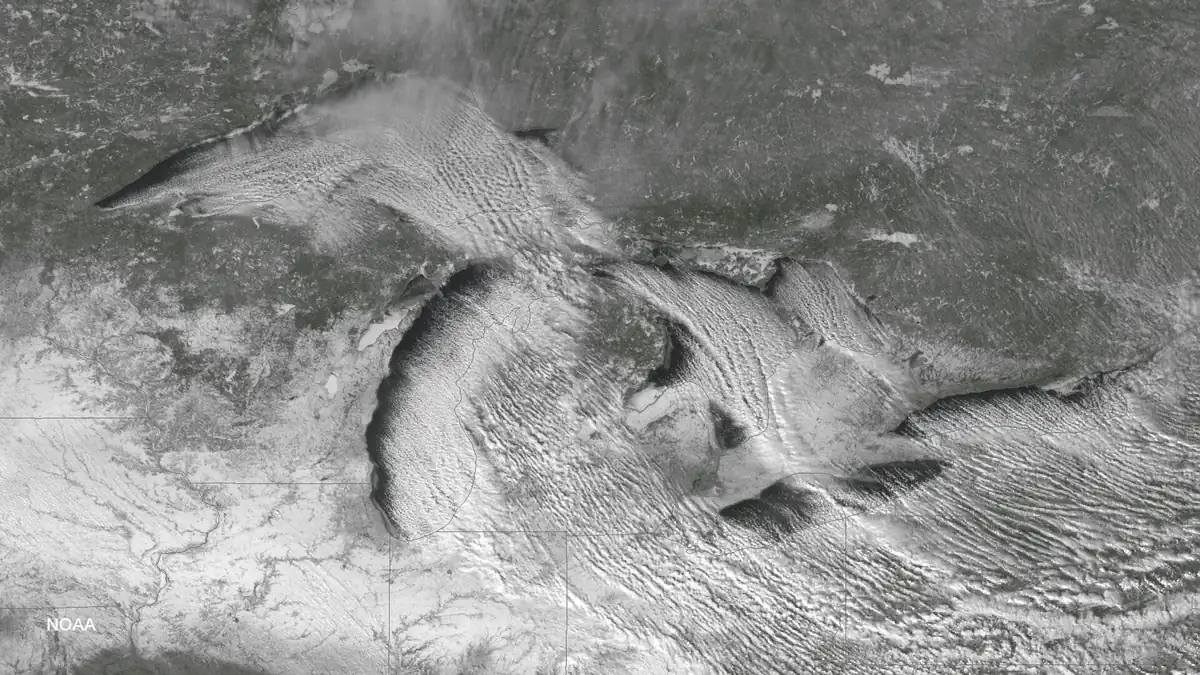
A Michigan snow day is never just about how much snow fell. A storm that closes schools in Detroit might leave the Upper Peninsula open, and a narrow lake-effect band can shut one west Michigan district while the next town over gets nothing. If you want to predict your district's call, you need to understand how Michigan districts decide, how lake-effect snow works, and what the state's six forgiven days really mean. This Michigan snow day guide puts all three together.
Everything below is general guidance drawn from typical Michigan district practice, not any district's policy. Michigan is a local-control state: each superintendent makes the call for their own district. Your district's official announcement is the only answer that counts for your family.
How Michigan districts actually decide
The decision usually lands in a narrow early-morning window, roughly between 4:00 and 5:30 a.m. Transportation directors and superintendents start checking conditions in the middle of the night: reports from plow crews, the latest hourly forecast from the National Weather Service, and often their own drive over the district's worst routes. They weigh whether buses can run every route safely — not just the town roads — whether staff can reach the buildings, and whether conditions will get worse before afternoon dismissal.
Timing matters as much as totals. Snow that falls overnight gives plows hours to work before buses leave the depot. Snow arriving between 6 and 9 a.m. hits roads at their busiest, with buses, parents, and commuters out at once. That is why the same six inches can mean a normal day in one storm and a closure in another. When a large, slow-moving storm is certain, some districts announce the night before; for fast-changing lake-effect or ice events, the morning check still matters.
Once the decision is made, notices go out through several channels at once: automated calls and texts, the district website and app, local television and radio, and school social media. Check your district's own channel first — social media rumors often run ahead of the real announcement, and sometimes get it wrong.
Michigan's six forgiven days: what the law really means
Michigan law requires districts to provide 1,098 instructional hours each school year. Districts are generally allowed up to six days missed because of conditions beyond their control — snow, ice, extreme cold, flooding, and similar emergencies — without losing state funding. Those are the famous "six snow days."
Once the six are used, extra closures usually have to be made up, most often by adding days to the end of the school year in June. Some districts add minutes to each school day instead, or build buffer days into the calendar before winter starts. In unusual circumstances the state superintendent may forgive up to three additional days, but that is a request, not a guarantee — districts plan as if they will have to make the time up.
This changes late-season behavior. A district that has burned all six days by February may feel real pressure to stay open in March, yet safety still comes first: closures remain possible, and the calendar simply shifts. Parents should watch for updated calendar notices in late winter, because the last day of school can move.
Lake-effect snow: Michigan's special problem
Lake-effect snow is why Michigan forecasts are so local. When cold arctic air moves across the relatively warm water of Lake Michigan or Lake Superior, it picks up moisture and drops it as narrow, intense snow bands on the downwind shore. A band can drop several inches per hour on one side of a county while the other side stays dry — which is exactly why neighboring districts make opposite calls on the same morning.
Michigan's main lake-effect zones are the Upper Peninsula (downwind of Lake Superior), the west Michigan snowbelt along the Lake Michigan shore from roughly Holland and Muskegon north through Traverse City and the Leelanau Peninsula, and the northwestern Lower Peninsula. The Thumb and the southeastern Lower Peninsula get lake effect too, but usually lighter, off Lake Huron and Lake Michigan. If you live in a snowbelt, your district decides by where the band sits, not by the county-wide snowfall total.
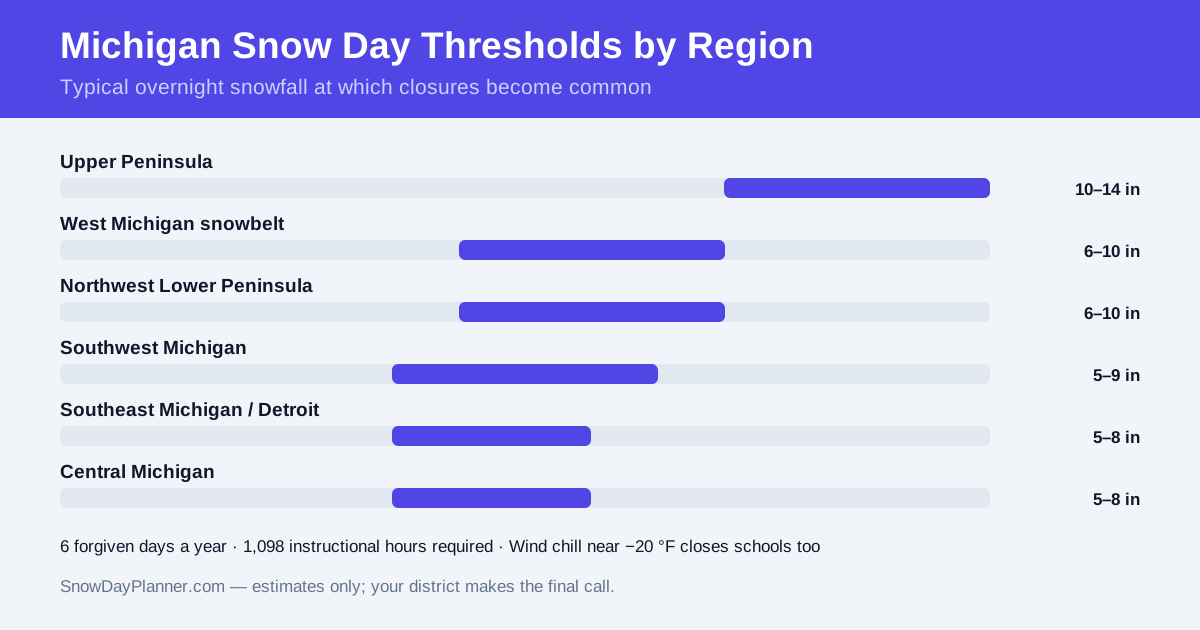
Typical thresholds by Michigan region
Use this table as general guidance only. Ice, wind chill, and storm timing can move every number, and your district's policy rules.
| Region | Delays become common | Closures become common | What usually decides it |
|---|---|---|---|
| Upper Peninsula | 6–10 in | 10–14 in or blizzard conditions | Deep snowpack routines; extreme cold; long rural routes |
| West Michigan snowbelt | 4–6 in | 6–10 in | Lake-effect band position; overnight rates |
| Northwest Lower Peninsula | 4–6 in | 6–10 in | Lake effect; hilly, rural routes |
| Southeast Michigan / Detroit area | 3–5 in | 5–8 in | Ice; morning commute timing; large bus fleets |
| Central Michigan | 3–5 in | 5–8 in | Mixed snow and ice; rural routes |
| Southwest Michigan | 3–6 in | 5–9 in | Lake effect near the shore; ice inland |
Two things override the table everywhere in Michigan. First, ice: even a quarter-inch of freezing rain can close schools at any snowfall total, because salt works slowly on ice and buses cannot brake safely on it. Second, wind chill: many districts close when sustained wind chills reach around minus 20 degrees Fahrenheit, because children waiting at bus stops face frostbite in minutes and buses may fail to start.
Delays versus closures in Michigan
A two-hour delay is the middle option Michigan districts use when roads need a little more time — for plows to finish, for daylight to improve visibility, or for temperatures to rise above freezing. Delays are common when the worst of the storm ends early in the morning, or when the problem is mainly ice that will melt once the sun is up.
A full closure is used when conditions will not improve in time, when the storm is still going at bus time, or when afternoon dismissal would be as dangerous as the morning run. If your district announces a delay and later upgrades it to a closure, that usually means conditions got worse on re-check — not that the first call was wrong.
How to check Michigan school closures
- Your district's official notice first. The district website, app, or automated message is the only authoritative source.
- Local TV and radio closure lists. Michigan stations run running closure lists on storm mornings; they are a good second check, but they repeat what districts announce.
- The hourly forecast, not just the daily total. Check the National Weather Service forecast for your town, including when snow arrives, whether ice is mixed in, and the wind chill at bus time.
- Our predictors as a planning tool. Enter your ZIP code in our snow day predictor or school closing predictor the night before to read the odds, and use the school delay calculator when a delay looks more likely than a closure. Learn how the scoring works on our how it works page, and see the statewide picture on our Michigan snow day page.
- A backup plan made the night before. Line up childcare before the announcement, not after. Mornings unravel fastest when the plan is made at 6 a.m.
Frequently asked questions
How many snow days does Michigan allow?
Districts generally get six forgiven days per school year for weather and other emergencies, within the 1,098-hour requirement. Extra days usually have to be made up, most often in June, though the state superintendent may forgive up to three more days in unusual circumstances.
What is lake-effect snow in Michigan?
Snow formed when cold air crosses the warmer Great Lakes, picks up moisture, and drops narrow, intense bands on the downwind shore. It explains why one Michigan town can get a foot of snow while a town twenty miles away gets almost nothing.
Why did my district close when the next district stayed open?
Districts differ in plow capacity, terrain, and route length, and lake-effect bands are extremely local. A rural district may close while a neighboring city district stays open, and both calls can be right.
Does ice close Michigan schools with no snow?
Yes. Freezing rain alone is one of the most common closure reasons in Michigan, especially in the southern Lower Peninsula. Even a thin glaze of ice can close schools that would stay open in several inches of snow.
When will I know if school is closed?
Most Michigan districts announce between 4:00 and 5:30 a.m., though major storms sometimes bring a night-before announcement. Keep notifications on and check the district's own channel first.
These thresholds are general guidance drawn from typical Michigan district practice, not any district's policy. Always follow your district's official announcement. SnowDayPlanner provides forecast-based estimates only; the final decision always belongs to your school district. For the official forecast behind any prediction, see the National Weather Service.
About the SnowDayPlanner Team
The SnowDayPlanner Team runs the snow day prediction model behind this site, combining live forecast data — snowfall, ice, wind chill and timing — with the closing patterns of thousands of school districts and boards. We publish how the model works and how accurate it has been, and we refresh predictions through the night as forecasts change, so the score you check in the morning reflects the latest data.