Snow Day Tracker: Live School Closure Watch
A snow day is decided twice — once by the weather, once by your district. This snow day tracker follows the first decision live: run your ZIP for the current score, then follow your state's status page as the storm develops and the announcement window approaches.
Published:
What the snow day tracker tracks
The tracker runs on the same engine as the snow day calculator: the next 24 hours of hourly forecast for your exact ZIP code, converted into closure odds by a published formula. What it keeps current for you:
- Live closure and delay scores for your ZIP — snowfall, timing, wind, cold and ice risk, refreshed as new forecast data lands every hour.
- The storm's shape, not just its total: snow in the 4–7 AM bus window counts more than the same snow at noon, and the tracker weighs it that way.
- State status pages for 17 states (below), where the regional picture — lake effect, ice belts, cold thresholds — is tracked state by state.
- The announcement rhythm: when districts in your state typically call it, and the morning checkpoints that matter.
What the tracker does not do is announce closures. No website can — that call belongs to your district alone, and any tracker that presents a prediction as an official closure is misleading you. Ours shows the weather half, live, and tells you exactly where the official half appears.
School closure status by state
Closure thresholds are regional — 5 cm closes schools in Texas and is a normal Tuesday in Minnesota. Each state page tracks its own patterns, announcement habits and the districts families ask about most:
- Michigan Snow Day TrackerLake effect, metro Detroit and the UP
- New York Snow Day TrackerLake-effect belts, the Hudson Valley and NYC
- Pennsylvania Snow Day TrackerLake Erie snow, the Poconos and both metros
- Ohio Snow Day TrackerThe Lake Erie snowbelt and river-valley ice
- Illinois Snow Day TrackerChicago lake effect and downstate ice storms
- Minnesota Snow Day TrackerExtreme cold, blizzards and metro storms
- Wisconsin Snow Day TrackerLake Superior snowbelt and lake-effect bursts
- Massachusetts Snow Day TrackerNor'easters and the rain–snow line
- Colorado Snow Day TrackerUpslope storms and March blizzards
- Indiana Snow Day TrackerMichiana lake effect and e-learning days
- Missouri Snow Day TrackerIce storms and metro snow bands
- Kentucky Snow Day TrackerIce storms, hills and NTI days
- Texas Snow Day TrackerIce on bridges and rare Arctic outbreaks
- Virginia Snow Day TrackerDC suburbs and mountain snow
- Georgia Snow Day TrackerAtlanta ice and forecast-only closures
- Washington Snow Day TrackerPuget Sound hills and Spokane snow
- Oregon Snow Day TrackerGorge ice and Portland closures
Beyond the states, the tracker also covers colleges, Canadian cities and Ontario school boards and the UK — and the ZIP tool above works anywhere in the US or Canada, listed state or not.
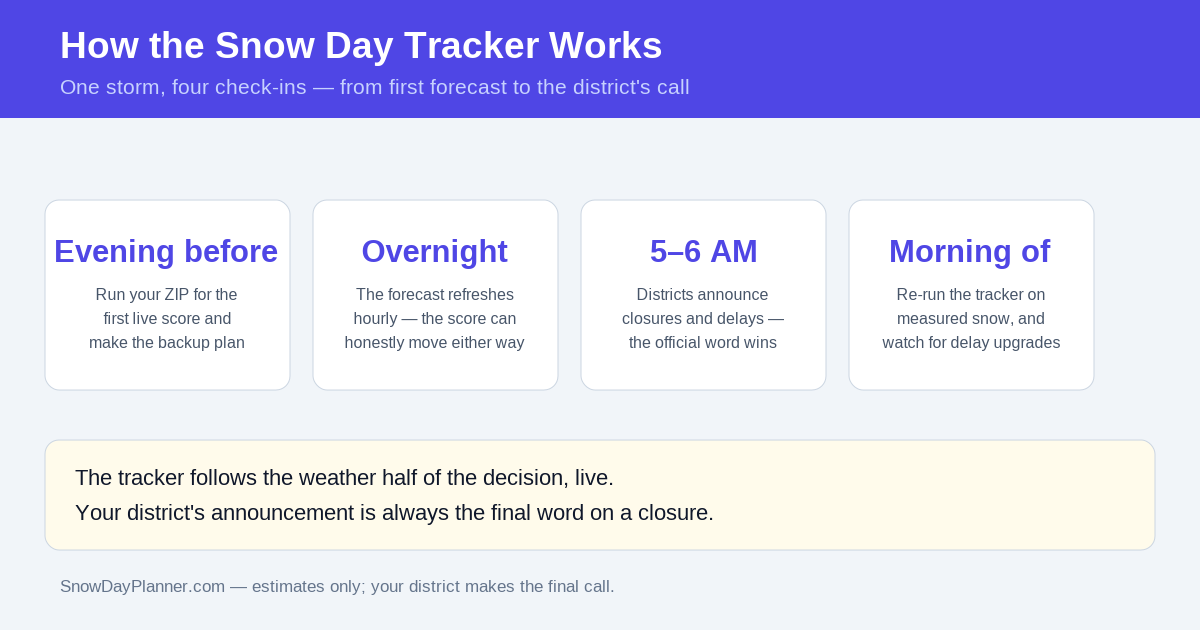
How to track a storm, step by step
- Evening before: run your ZIP here or on the snow day calculator for tomorrow. A score above 50% means set the backup plan tonight.
- Overnight: the forecast refreshes hourly. Do not screenshot the evening score — re-run it in the morning; the number is allowed to change.
- 5–6 AM: check your district's website, app or hotline and the local news closing ticker. This is the official announcement window.
- Morning of: use the today page for the morning-of checklist — and remember a 2-hour delay can still upgrade to a full closure by about 8 AM.
The two companion pages split the job by timing: will there be a snow day tomorrow for the night-before call, and is it a snow day today once you wake up to snow.
Tracker vs. the official announcement
Think of the tracker as tracking the same inputs your district's transportation team watches: the National Weather Service forecast and warnings for your county, and road conditions as crews report them. Our forecast data comes from Open-Meteo, the open weather service built on national meteorological models. The district then adds what no forecast can see — plow progress, bus staffing, building heat — and makes the call. When the tracker and the announcement disagree, the announcement is right by definition; our accuracy page explains honestly how often that happens and why.
Why the score moves overnight
A tracker that never changed its number would be lying to you. Overnight the forecast stops describing the future and starts describing the present: snow arrives early or late, a degree of warmth turns snow to rain, a lake-effect band shifts one county over. The score follows the newest hourly data, which is exactly what you want at 5:30 AM. The full formula is published, so every move in the number can be traced to a move in the weather.
Start tracking tonight
If snow is in your forecast, the routine takes a minute: run the snow day tracker above, glance at your state page, and set two check-ins — one tonight, one at 5:30 AM. The snow day calculator will keep watching the weather half; your district's announcement settles the rest.
Frequently asked questions
What is a snow day tracker?
A snow day tracker follows a winter storm as it develops and keeps your school closure odds current: the live forecast for your ZIP, the closure and delay scores it produces, and the state status pages where districts in your state are tracked. Ours runs on the same engine as the snow day calculator, refreshed with new forecast data every hour.
How often does the snow day tracker update?
The underlying forecast data refreshes hourly and results are cached for at most one hour. That is deliberate: overnight, a storm track shifting even 50 miles can flip the picture, so the evening score is a planning tool and the early-morning score is the one to act on.
Does the tracker show official school closures?
No — and be wary of any site that claims to. Only your district can announce a closure. The tracker shows the live weather side of the decision and links you to your state's status page; the official word always comes from your district's website, app, hotline or local news ticker, usually between 5 and 6 AM.
Which states does the tracker cover?
Seventeen state pages — Michigan, New York, Pennsylvania, Ohio, Illinois, Minnesota, Wisconsin, Massachusetts, Colorado, Indiana, Missouri, Kentucky, Texas, Virginia, Georgia, Washington and Oregon — plus city pages, Ontario school board pages, and college and UK pages. The ZIP-level tracker itself works anywhere in the US and Canada.
When do districts announce snow day closures?
Most announce between 5 and 6 AM, after road crews report and before the first buses roll. Forecast major storms are sometimes called the evening before. If nothing has been announced by about 6:30 AM, school is almost certainly on — but a morning delay can still upgrade to a closure by around 8 AM.
Is the snow day tracker free?
Yes. The tracker, the calculator and every state page are free, with no account and no download. It is the same tool as the snow day calculator app page, in your browser.
About the SnowDayPlanner Team
The SnowDayPlanner Team runs the snow day prediction model behind this site, combining live forecast data — snowfall, ice, wind chill and timing — with the closing patterns of thousands of school districts and boards. We publish how the model works and how accurate it has been, and we refresh predictions through the night as forecasts change, so the score you check in the morning reflects the latest data.